
Overall Rating 5
Sixteen, written and performed by Frankie Baker, is a challenging and thought provoking commentary of a teenager’s improper relationship with a schoolteacher. Delving into issues relating to desire, consent, abuse of position, guilt, shame, embarrassment, and self-doubt, it is an exceptionally moving and heartfelt portrayal of a gamut of emotions that can only arise after a sustained period of reflection and emotional growth, and is delivered with raw honesty which adds an abundance of power to Baker’s performance.
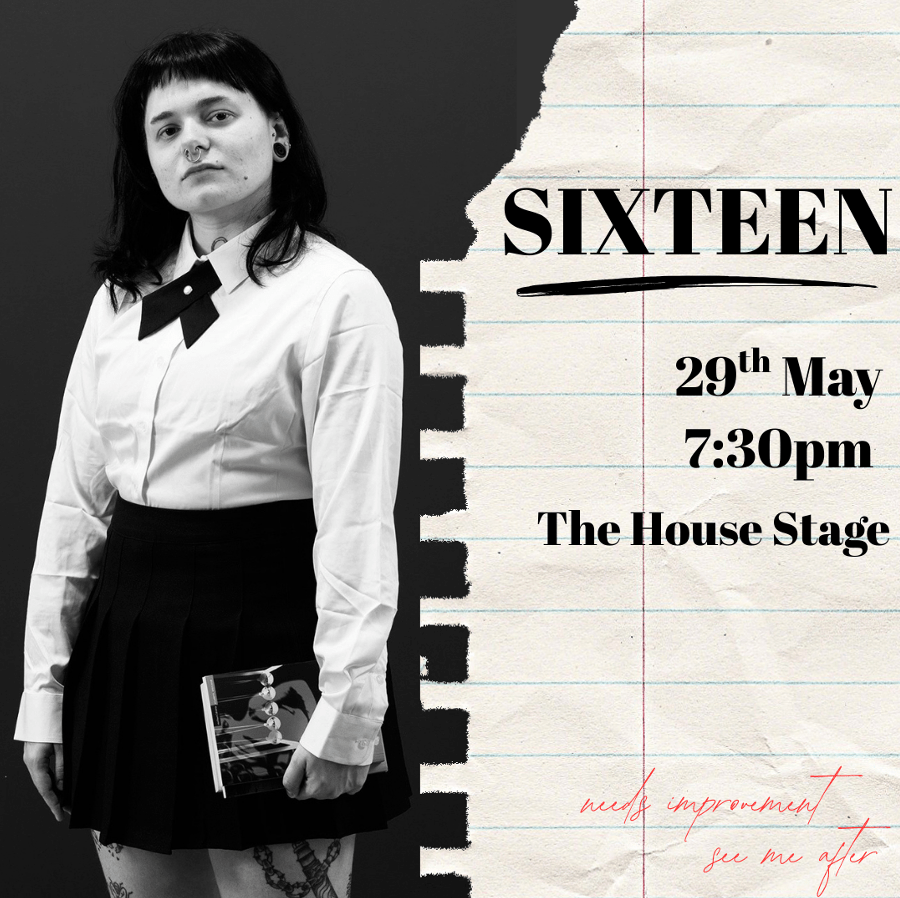
Upon entering the auditorium the audience are met with simple set up of a table and two grey chairs placed on a large white rug. Baker, dressed as a schoolgirl in blouse, tie, short pleated black skirt, with stockings and black heels is seductively dancing solo and miming to Taylor Swift’s ‘Guilty as Sin’ whilst the audience settled in. Front stage left is a microphone on a stand whilst the scene is filmed and projected to a screen at the back of the stage. Empty prosecco bottles lie strewn on the floor and a vase of lilies sits on the table. These props are subtly referenced throughout the performance and it was clear from the outset that significant thought was put into the staging of the piece as a visual entity.
The show begins with Baker taking to the microphone to set the scene. The performance (in the form of a poem read from a teenager’s diary) sets out a little of the character’s past inferring that she had suffered abuse as a younger child and that now, at 16, she has developed a crush on her 50 year old married drama teacher, before going on to chronicle the development of an association which is improper, yet much of which takes place in plain sight of the character’s classmates.
From standing at the open microphone, the dialogue shifts around the stage making excellent use of the set to portray both a teenager’s bedroom and a school drama studio. Of particular note, was the use of a chair in a provocative manner and Baker’s use of the camera when describing in detail the performance of a sexually explicit scene from Patrick Marber’s ‘Closer’ and subsequent filming for an examination, (discovered to be unnecessary) for which Baker stepped out of her blouse, tie, skirt and shoes to remain simply in her underwear. Use of the camera to portray the feeling of being watched was a simple but effective masterstroke.
The narrative of the piece was incredibly well paced and pitched and significant credit has to be given to Baker for this. It would have been very easy to simply tell this story in a matter of fact manner and I was very impressed by the changes of pace and direction of the narrative storytelling. On several occasions the text was interspersed with adjectives, delivered with quick fire precision before the piece was brought back to a more sombre pace and tone. The effect of this kept the audience’s attention throughout and was an excellent method of portraying the effect of the teacher’s behaviour on the character. In addition, her nuanced eye contact with the audience had the desired effect of drawing us into her thoughts and emotions with superb intimacy, keeping us enthralled.
It would be wrong of me not to mention that the performance itself was followed by a Q&A with Baker and that only at this point did I learn that the production was autobiographical, something which enabled those who were not aware of this to see the production in a different light and on a very different level. Baker’s first-hand experience of the subject matter and her ability to use it in such a way to show that she is not now the result of those experiences, but everything else, is incredibly uplifting and of real credit to her and her work.
Reviewed by Matthew Becker
 Plymouth Theatre Review
Leave a comment