
‘Bodyscape’ by Stephen Harding offered a bold and abstract exploration of movement, visual art, and sound. This interdisciplinary performance brought together elements of dance, live art-making, and experimental sound design to create a layered sensory experience.
The piece began with the audience facing a closed curtain—an effective decision that helped build anticipation. When the curtains opened, a minimalist stage was revealed, with a collection of artists’ materials positioned downstage right. Harding entered to a soundscape of nebulous chords and began setting up a series of easels, accompanied by a shifting soundscape of ambient noise and indistinct vocal fragments. Behind, a female dancer began moving in free-form patterns, casting fleeting shadows and forming visual counterpoints to the action in the foreground.
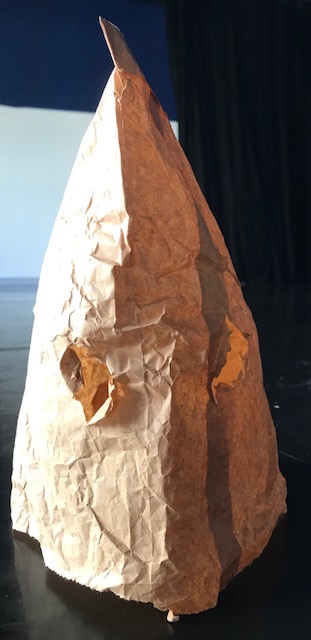
Throughout the performance, the dancer’s movements interacted loosely with the space and the evolving installation, although they never seemed to communicate with each other, she moved sometimes around the easels, sometimes on stage, sometimes casting her shadow on the psyche. Meanwhile, the male performer underwent a series of costume transformations, layering sackcloth, rope, and paper bags in a symbolic but deliberately opaque sequence. These elements, while evocative, offered little in terms of narrative clarity, resulting in a performance that leaned heavily on atmosphere and intuition rather than linear storytelling.
The interaction between the two performers remained largely non-verbal and non-contact, suggesting themes of parallel existence or disconnected communication. In the final section, the dancer applied spiral shapes to the easels, which were then altered by the artist using what appeared to be mud, creating handprint impressions that further blurred the lines between movement, mark-making, and ritual. The performance concluded with the performers kneeling opposite each other in what appeared to be the first moment of shared focus—though still without dialogue—before quietly exiting the stage.
While intentionally abstract and at times elusive in meaning, Bodyscape maintained a consistent aesthetic and mood. The performers demonstrated strong physical control and commitment, and the piece as a whole offered an immersive encounter with non-verbal and abstract expression. For some, the lack of traditional structure or discernible narrative may have felt distancing, but for others, the work invited open interpretation and engaged the imagination. For me there was a real performance fascination in watching these very able artistes share their world with the audience, and l will stand up until the death to defend the artistic integrity demonstrated in Bodyscape.
Ultimately, Bodyscape reflected a confident experiment in cross-disciplinary performance. Its strength lay in its willingness to embrace ambiguity and provoke thought through form rather than text. It served as a fitting reminder of the creative risk-taking that underpins the ethos of art and artistic expression.
 Plymouth Theatre Review
Leave a comment