
Easy to Follow: 4
Family Friendly: 3
Must see: 4
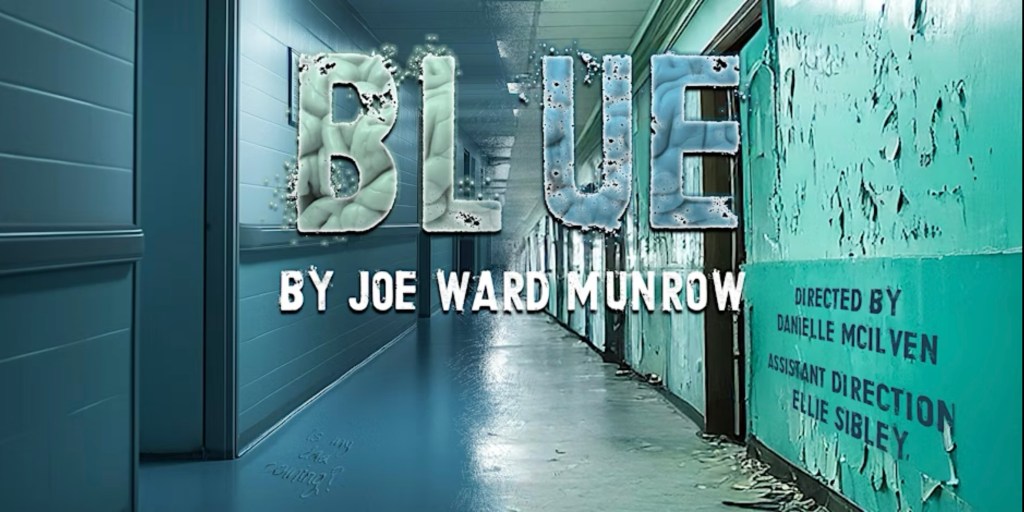
Title: ‘Blue’
Venue: The House, University of Plymouth
Joe Ward Monroe’s ‘Blue’ is a powerful piece of theatre that delves into themes of identity, monotony and emotional isolation. The play displays a world where the ordinary is made unsettling and characters constantly revolve around one another, in a monotonous carousel of humanity and human connection. This was, in my opinion, a particularly inspired choice for a student ensemble piece as it not only challenges the young cast but allows them to shine in the kind of complex, character-driven material that demands subtlety and deep understanding of character, relying on their storytelling and characterisation skills to effectively tell the story. It is an exploration of how we become trapped in routines, and the difficulty of breaking free from those cycles, especially in a clinical setting, where the characters already have a diminished agency over their own lives.
The set designed portrays a cylindrical, minimalism that reinforces the play’s central idea of repetition and stagnation. Characters enter and exit with a near-mechanical rhythm, creating a constant flux of energy and pace that adds to the play’s momentum and instils a sense of ordered chaos to the audience. The staging is simple but effective, cleverly evoking in me a sense of isolation even when the space is not empty. It feels like a revolving door of humanity, lives intersecting, colliding, then drifting back into shadow. The actors entered and exited via the same pathways, creating a clever revolving conveyer belt of action, that flowed into each other seamlessly.
Sound and lighting design also elevated the atmosphere of the piece, adding to the clinical and structured feel of the work and served as a constant reminder to me that these were characters in a state of transition even though we rarely saw progress in the characters somewhat stagnant existence. The soundscape is detailed and highly effective, pulling the audience into the world of Blue with atmospheric textures that echo the characters’ inner turmoil and push the audience further into the action. Sudden audio shifts are all used to communicate the tension and unease. Likewise, the lighting is imaginative and emotionally resonant, shifting with the characters’ moods and helping to mark transitions in time. Together, these elements create a haunting, immersive environment that mirrors the play’s psychological depth and draws us into the action, and therefore the lives of the characters further.
The ensemble cast handles the material with impressive maturity, with several performances standing out for their characterisation and emotional clarity. Anna Batson’s portrayal of Matty is particularly noteworthy. She is profoundly convincing, embodying a character who is vulnerable and guarded, fragile yet aggressive and stubborn in nature. Batson masters the emotional tightrope that could easily veer into melodrama but instead feels real, lived-in, and deeply affecting. Her performance anchors many of the show’s most moving moments, offering a portrayal of internal struggle and despite the characters sometimes harsh nature, adds some much needed humour to the work.
Laura Rosa also delivers an exceptional performance as Lucy, bringing sharp intelligence and aching vulnerability to the character. Rosa’s command of stillness and silence is particularly striking, she knows exactly when to let the moment breathe, giving us space to connect with her character’s unspoken emotions. Elliot Fenn’s Jon is full of restrained energy and conflicted charm. Fenn captures the kind of quiet desperation that defines many of the play’s characters, using subtle shifts in posture, voice, and timing to reveal the tension between his character’s outward composure and inner disarray. The characterisation and understanding of character is strong and this endears us to the characters and invests us into their lives and therefore the story.
What makes Blue such a smart choice for a student ensemble is its demand for cohesion and attention to nuance. Every character feels essential, even those who drift almost silently through the story in brief appearances. The play doesn’t rely on grand narrative arcs, instead, it focuses on emotional truth that gives each performer space to craft detailed, emotionally grounded roles. The ensemble is responsive, connected, and committed to the shared language of the piece.
‘Blue’ is a quietly devastating portrait of everyday disconnection and a testament to what student theatre can achieve when ambition meets careful craft. This production makes full use of its creative resources, with imaginative design elements and standout performances that elevate the text and propel the audience into the world of the characters and narrative. Thoughtful, innovative, and deeply felt, this production demonstrates the strength and maturity of emerging theatre artists.
 Plymouth Theatre Review
Leave a comment